Lower Total Cost of Ownership (TCO): The cloud model eliminates expenses related to on-premise infrastructure, such as servers, IT staffing, and physical storage

Top reasons why companies are choosing SAP Cloud ERP
This blog article explores the top reasons companies are
choosing SAP Cloud ERP (technically SAP S/4HANA Cloud Public Edition) and part of SAP Business Suite today and how it can drive significant business value for organizations of all sizes.

Why is Everyone’s Switching to modern SAP Cloud ERP?
In an era defined by constant disruption and rapid innovation, organizations must rethink how they operate to stay ahead. The ability to adapt, scale, and make informed decisions in real time has become essential for maintaining a competitive edge. Forward-looking companies are embracing cloud-first strategies to modernize their core processes, increase resilience, and accelerate growth. A solution gaining strong momentum is SAP Cloud ERP, specifically the SAP S/4HANA Cloud Public Edition, which offers a standardized, scalable foundation for transformation. In this article, we explore eight key drivers behind the move to cloud-based ERP and why leading organizations are making this transformation a priority today.
1. Cost Efficiency and Predictable Expenses
One of the most attractive features of SAP Cloud ERP is its subscription-based pricing model, which offers a predictable cost structure. Unlike traditional on-premise solutions, there is no need for upfront investments in hardware or ongoing maintenance costs.
Key Benefits:
-
-
Scalability Without Financial Strain: Businesses can scale up or down as needed without incurring significant costs, making it ideal for growing companies
-
Built-In Maintenance: SAP manages updates, security patches, and system performance, reducing IT overhead for your organization
2. Faster Time-to-Value with Rapid Deployment
SAP Cloud ERP is designed for rapid deployment, enabling companies to start using the system in weeks rather than months. Its fit-to-standard approach minimizes complex customizations, allowing organizations to adopt industry best practices from the outset.
Why It Matters:
-
Quick Implementation: Accelerated implementation ensures businesses can begin reaping the benefits sooner
-
Standardized Processes: Preconfigured templates streamline operations and reduce implementation time
-
Focus on Achieving Results: Organizations can focus on innovation rather than lengthy configuration processes
3. Real-Time Data and Analytics for Better Decision-Making
SAP S/4HANA Cloud leverages the powerful in-memory SAP HANA database, enabling real-time data processing and analytics. Businesses can access accurate, up-to-date insights to drive informed decision-making.
Key Advantages:
-
Enhanced Visibility: Gain a 360-degree view of business operations with dashboards and KPIs
-
Faster Reporting: Eliminate delays caused by batch processing in legacy systems
-
Predictive Analytics: Use AI-powered insights to anticipate market trends and customer needs
4. Continuous Innovation with Regular Updates
Companies adopting SAP’s Public Cloud solution benefit from a commitment to continuous innovation. SAP delivers two major upgrades annually, typically in February and August, along with bi-weekly patches through Hot Fix Collections (HFCs) to address minor corrections and enhance system functionality.
Why Companies Value Regular Updates:
-
Stay Ahead of the Curve: Access new capabilities, industry best practices, and enhanced security features
-
Minimal Downtime: Updates are managed by SAP with no disruption to business operations
-
Future-Proofing: The system evolves with emerging technologies like AI, machine learning, and IoT
5. Scalability and Flexibility for Growing Businesses
SAP Cloud ERP is designed to scale with your business. Whether expanding into new markets, launching new products, or accommodating seasonal demand, the cloud infrastructure supports dynamic growth.
How It Helps Growing Companies:
-
Elastic Resources: Scale resources up or down based on real-time needs
-
Global Reach: Multi-language and multi-currency support make it ideal for international operations
-
Flexible Licensing: The subscription-based model allows businesses to pay only for what they need
6. Enhanced Security and Compliance
With SAP managing the cloud environment, businesses benefit from enterprise-grade security and robust compliance standards. This is particularly valuable for companies operating in regulated industries such as healthcare, finance, and manufacturing.
Security Features:
-
Data Encryption: Protects sensitive business information in transit and at rest
-
Proactive Monitoring: 24/7 system monitoring to detect and mitigate threats
-
Compliance Assurance: SAP adheres to global standards, including GDPR, ISO, and SOC certifications
7. Simplified IT Operations
SAP Cloud ERP eliminates the need for on-premise infrastructure and its associated complexities. IT teams can focus on strategic initiatives rather than managing hardware, servers, and manual updates.
Key Advantages:
-
SAP-Managed Updates: Semi-annual upgrades, bi-weekly patches, and security maintenance are all handled by SAP
-
Reduced IT Overhead: Free up IT resources to work on innovation rather than system maintenance
-
Cloud-Native Architecture: Take advantage of seamless integrations with other SAP solutions and third-party applications
8. Fit-to-Standard Processes Aligned with Best Practices
The fit-to-standard approach of Walldorf Consulting for SAP Cloud ERP implementations ensures that businesses can align their operations with proven industry practices. By adopting preconfigured processes, companies can reduce customization costs and streamline operations.
Benefits of Fit-to-Standard:
-
Efficiency: Standardized workflows eliminate redundancies and improve process flow
-
Faster Deployment: Reduced customization allows quicker system adoption
-
Simplified Upgrades: Standardized processes ensure compatibility with future updates
Why Companies Are Transitioning from SAP ECC or SAP ByDesign to SAP Cloud ERP
Organizations currently using SAP ECC or SAP Business ByDesign (SAP ByD) are recognizing the need to transition to SAP Cloud ERP to stay competitive and future-ready. For ECC users, the end of mainstream maintenance by 2027 is a significant driver, as businesses must upgrade to avoid operational disruptions and to gain access to SAP’s latest innovations.
Similarly, companies using SAP ByD are transitioning to the modern Cloud ERP (SAP S/4HANA Cloud Public Edition) to leverage its advanced capabilities, scalability, and integration options. While ByD was a solid ERP for smaller businesses for long years, S/4HANA Cloud offers a robust platform that supports more complex operations, deeper analytics, and seamless integrations with SAP’s broader ecosystem.
Key Drivers for the Transition:
1. Future-Ready Technology
Transitioning to S/4HANA Cloud ensures access to SAP’s cutting-edge technologies, including artificial intelligence (AI), machine learning, and advanced analytics.
2. Improved Performance
S/4HANA’s in-memory HANA database delivers real-time data processing and faster reporting compared to ECC or ByD.
3. Cloud Benefits
Companies gain the advantages of a cloud-first approach, including scalability, lower TCO, and automatic updates.
4. Unified System
SAP Cloud ERP is part of the SAP Business Suite and offers seamless integration across business functions, allowing for more streamlined operations and improved collaboration.
5. Strategic Alignment
The move aligns with SAP’s long-term vision, ensuring companies remain aligned with SAP’s roadmap and future innovations.
For ECC and ByD users, the transition to SAP S/4HANA Cloud is not just a technical upgrade but a strategic move to adopt a modern, agile ERP system that supports growth and innovation.

Conclusion: Why Choose SAP Cloud ERP Today?
The pressure to evolve has never been greater. Businesses need solutions that not only meet today’s demands but also position them for tomorrow’s opportunities. A modern cloud ERP delivers just that: enabling agility, reducing complexity, and laying the groundwork for innovation at scale.
At Walldorf Consulting, we guide organizations through this transition with a proven, low-risk approach that balances technology with the human side of transformation. With our expertise and SAP’s GROW offering, your move to the cloud becomes more than an upgrade. It becomes a strategic advantage!
Let’s shape your future, together! Reach out to Walldorf Consulting and discover how a smart cloud transformation can power your next phase of growth.


Blog
Comparison SAP Cloud ERP vs. SAP ByDesign
Blog
Why Professional Services Should Consider SAP Cloud ERP
Blog
SAP Cloud ERP: Public vs Private Cloud Explained
Blog
Is SAP Cloud ERP Right for Your Business? Find out Now!

Blog
Mastering SAP Cloud ERP Implementation on Track & Budget

Blog
7/21/25
SAP simplifies the naming of its cloud ERP offering

Success Story
TIMETOACT GROUP - Digital Transformation with SAP Cloud ERP

Whitepaper
HBR - Driving Growth with Cloud ERP for Services Companies

Technologie
SAP Partnership for Business Excellence

Blog
Timetracking for SAP S/4HANA® Cloud by Walldorf Consulting
News
2/26/26
SAP qualified Cloud ERP Package for Professional Services

Blog
SAP Business Suite: Structure, Licensing, User Types

Blog
Cloud ERP & AI: Scalable Innovation in FinTech
Blog
Unlock Hidden Gold: Uniting Finance, IT & HR Leaders

Blog
4/8/25
The End of SAP Business ByDesign
News
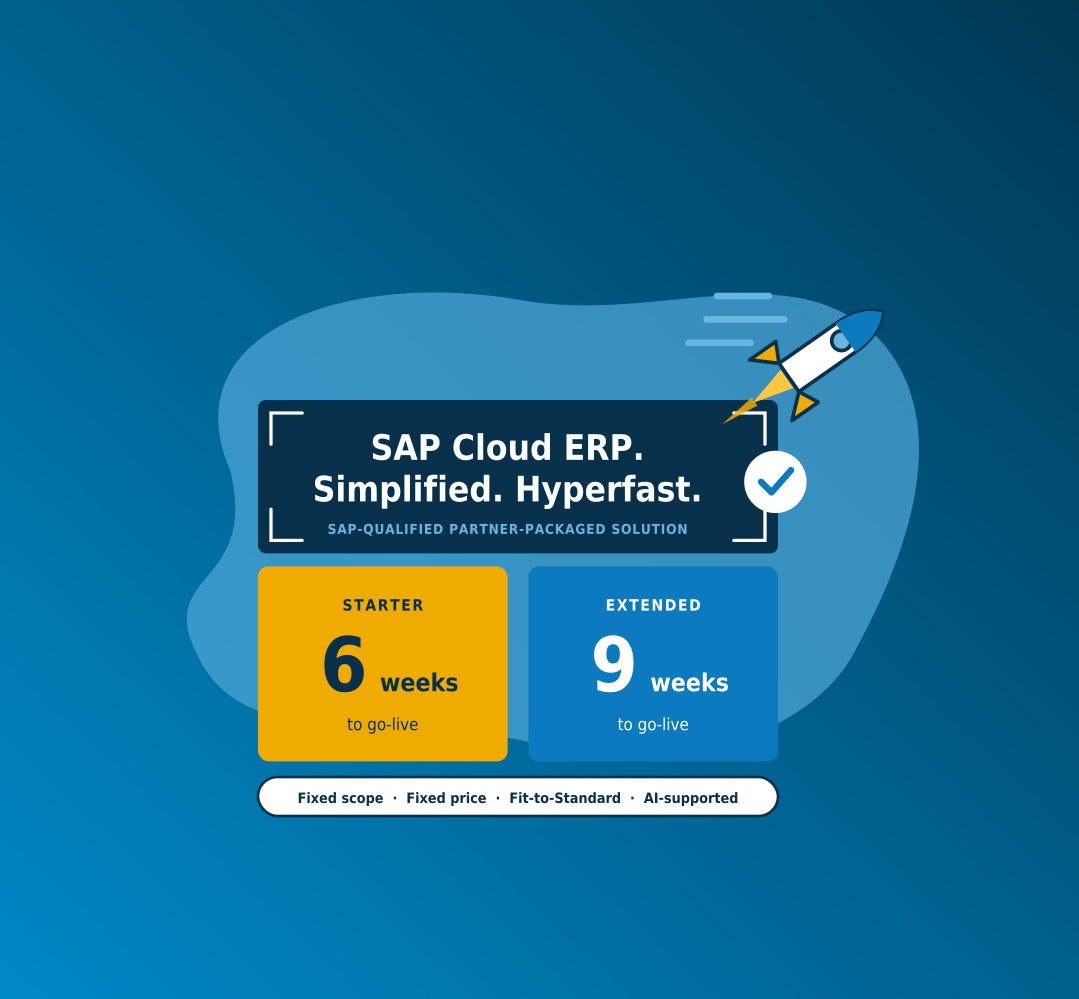
SAP Cloud ERP. Simplified. Hyperfast.
Offering
Empower Your Future Business with Cloud ERP

E-Book
Transition from SAP ByDesign to S/4HANA Cloud

Podcast
3/31/25
Future of ERP Podcast with Simon Flick

News
5/7/26